
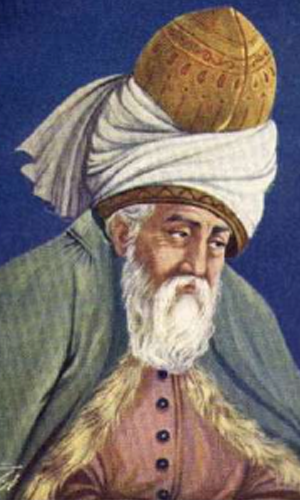
Divine Face of Maulana Jalal ud Din
Muhammad Rumi
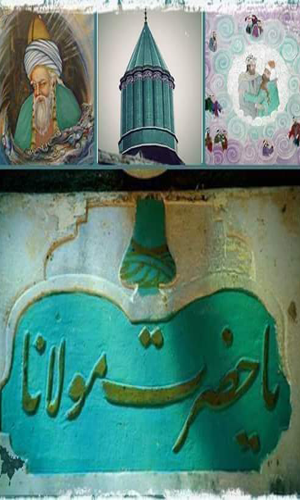
Rumi's Discourse on True Love Masanavi Vol1
The whole world wants to be a paradise. Not a singe person seeks love

A window to Mathnavi Maulvi Ma’nvi
Translation and Commentary Seema Arif
Further Links for Rumi
- Dar ul Masnavi
- Diwan-i-Shams
- Fi hi Mah Fi (Discourses)
- Whinfield on Rumi
- Raza Rumi
- Khamush
- Poetseers
- The Republic of Rumi
- My papers on Rumi
- Life and Works of Rumi
1) The astrolabe is an ancient astronomical device, “an instrument for measuring the altitude of the stars and solving the problems of spherical astronomy.” Love is the astrolabe, which means that only Love can “measure” and understand the depths of Divine mysteries– not the intellectual reason (Nicholson’s Commentary).
(2) Being a lover eventually guides us to the Source of Love, God, the Only Beloved. Love, whether its immediate object is Divine or human, real or phenomenal, leads ultimately to cognizance of God and union with Him. All earthly beauty is but the reflection of Heavenly Beauty, and as the reflection fades away we turn our eyes towards the light whence it came.”
(Nicholson’s Commentary)
(3) The meaning of “Love (expressed) without the tongue is (much) clearer “: “i.e., the signs of Love, such as agitation, pallor, and tears, speak for themselves. Cf. the saying, (lisánu’ l-hál antaqu min lisáni’ l-maqál), ‘the tongue of inward feeling is more eloquent than the tongue of discourse’.” Illumination is a state in which everything becomes self-obvious because it has sufficient light reflecting from it. More than physical symptoms of Love, Rumi says that Love is more obvious from the attention and care one bestows and sacrifices one makes for one’s beloved. Actions speak louder than tongue.
(4) Reason has much to do with material obvious things, which it can explain well. It has no reach to the spiritual realm and principles governing it. Therefore, it is powerless and helpless in such matters. This is a mystery that Love reveals to the lover by immediate experience (man l am yadhuq l am yadri), i.e., He who doesn’t taste doesn’t know. (Nicholson’s Commentary)
(5) Imam Abu Hanifa hath said, “Practice what you have learned, for theory without practice is like a body without a spirit.” He who is contented with learning alone is not learned, and the truly learned man is not content with learning alone. Similarly, Divine guidance (hidayyat) involves self-mortification.
(mujahadat), without which contemplation (mushahadat) is unattainable. There is no knowledge without action since knowledge is the product of action and is brought forth, developed, and made profitable by the blessings of action. The two things cannot be divorced in any way, just as the light of the sun cannot be separated from the sun itself (Kashaf-al-Mahjub, p. 95).
(6) God is ‘near the jugular vein’ as told in the Qur’an (50:16), and everything nearby or far in the universe is just indicative of His Divine presence.


(7) Splitting of the moon is a miracle ascribed to Hazrat Muhammad (SAW). (Qur’an, 54:1). It reflects the dawn of Truth, because the moon’s light is borrowed from the sun, whereas the sun is the genuine leader of the stars in Heaven. Therefore, when a true leader takes hold, the contemporary leaders are passed.
(8) Again, the concept of Tawhid is firmly established; God is
One and omnipotent. Although nobody has seen an illuminating body like the sun (till Rumi’s time), one can think of a hundred likenesses of the sun, a created being itself, but no one can conceive of God what He really is.
(9) Shams of Tabriz was the spiritual mentor of Rumi. He was his soul companion. Rumi had discovered multiple spiritual states and stations with Shams. Therefore, Rumi had deep regard and Love for Shams; he honors both his knowledge (which hath illuminated his soul like the sun lightens up the world) and the friendship that had supported him and consoled him while treading on the difficult path of spiritual enlightenment. He has referred to the contribution of Shams throughout his life in Mathnavi.
(10) Fana, annihilation is the most desired Sufi state, i.e., to claim union with God. It involves neutralizing or abandoning baser human instincts, thoughts, and values (such as doubt, suspicion, jealousy, and arrogance) noted as human attributes to acquire divine virtues (such as patience & magnanimity) acclaimed and practiced by saints and prophets. Click for Detail.
(11) In the words of Junayd (ra), intoxication denotes heightened longing and extremity of Love; neither can be reached by human effort alone. Sobriety denotes soundness of spiritual state. As quoted in Kashaf-al-Mahjub, p.189. Click for Detail
(12) In the state of intoxication, the person may talk in a way that makes no sense, like delirium. A person may appear to be disrespectful, indecent, even a lunatic or a heretic to the common in a delirious state. Therefore, the select Sufis are advised to keep sobriety.
(13) The true interest of a Sufi is self-abandonment. When the attraction of Truth manifests its dominion, all his actions are confounded, and he loses all powers of expression; nor can any name be applied to him, any description be given of him, or anything be attributed to him. Shibli has said (Kashaf-al-Mahjub p. 195)
“I am lost to myself and unconscious, And my attributes are annihilated.
Today, I am lost to everything: Naught remains a forced expression.”
(14) The “soul” seeks knowledge of a friend. It wants Union with the Ultimate Truth.
(15) Time is a cutting sword because it is characteristic of a sword to cut, and “time” cuts the root of the future and the past, obliterating the care of yesterday and tomorrow from the past and obliterating the care of yesterday and tomorrow from the heart.
Time is beyond human acquisition; it is hard to find, as it is neither sold nor exchanged, and one has no power to attract or repel time. A sword must be respected and managed with care; violence, being its essential attribute, would favor none, not even its possessor or the loved one of the possessor (Kashaf-al-
Mahjub, p.369).
(16) According to mystic tradition, ‘Ibn-al-waqt’ is a Sufi experiencing an unbounded spiritual state, which reflects the gifts he has been bestowed. He is more prone to being ‘reactive’ and acquiring emotional mode, and he is termed “Qalandar” and “Rind” as well. (Masnavi Maulvi Ma’navi, Urdu Translation & commentary by Qazi Sajjad Hussain, vol.1, p. 45).
(17) ‘Ibn-al-Haal’ is the Sufi fully in control of his spiritual state; he never lets the common guess his spiritual heights, that he has reached the knowledge of Essence. Click for Detail. Waqt/Haal KML
(18) Abu Ali Juzjani would say, “ The saint is annihilated in his own state and subsistent in the contemplation of The Truth.” In contemplation, it is impossible to regard only God. He cannot be at peace with anyone but with God because a man knows only his own state, and when all his states are annihilated, he cannot tell anything about himself. He cannot relate it to any other human being because to tell of one’s hidden state to another is betrayal, revealing secrets of the Beloved, and no one can hold that but The Beloved Himself (Kashaf-al-Mahjub, p.216).
(19) Abu Hamid Al-Balkhi would exclaim, “It is wrong to seek the way since the way to God is like the blazing sun; do thou seek thyself, for when thou hast found thyself, thou art come to thy journey’s end.” God is too manifest to admit of His being sought. He has also recommended, “Hide your poverty, do not
Proclaim yourself to be a Sufi (dervish), lest your secret be discovered, for it is a great grace bestowed on thee by God.”
(20) It is again talking of union. One cannot be subsistent with God in Essence. It is only achieved through annihilation of annihilation. Click for Detail. (hyperlink for Kashf ul Mahjub page “Annihilation”)
(21) All boundaries crossed; there is nothing in-between, hither or thither, all is spread to nothingness. As stated above, it is a state of knowledge of Truth, complete annihilation.
(22) It reaffirms the omnipotence of Allah the Almighty; human reason and logic must humble itself before it. As established in Spiritual Reverence. Click for details.
(23) Again, the preference for “sobriety” has been claimed. Disturbing Divine ordinance hails destruction. The only solution is surrender, i.e., understanding and following Divine Law. One of the purposes of writing Masanavi was to declare the true path of the way, i.e., how to acquire spiritual purification and relieve the way from unholy rhetoric.
Copying without permission will be considered violation of copyright. You may quote using proper referencing methods.